The quiet hum of exhaustion has become your constant companion. You wake up tired, push through your workday in a fog and collapse into bed only to repeat the cycle tomorrow. If this sounds familiar, you’re not alone. Burnout has become an epidemic among working professionals, but there’s a gentle path forward: yoga for burnout recovery offers a scientifically-backed approach to restore your depleted energy, calm your overwhelmed nervous system and rebuild your resilience from the inside out.
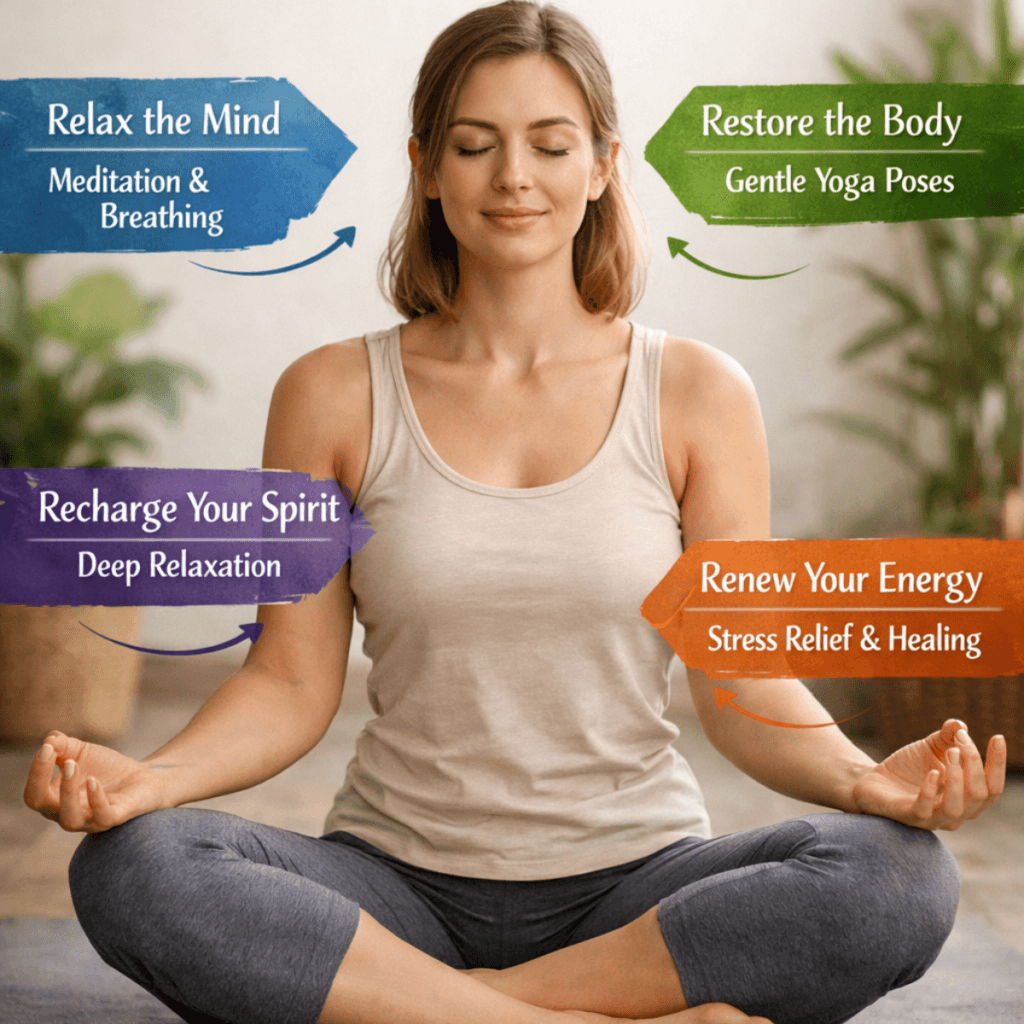
Table of Contents
Understanding Burnout: More Than Just Feeling Tired
Before we explore how restorative yoga can help, it’s essential to recognise what burnout truly means. Unlike everyday stress or fatigue, burnout is a state of complete physical, emotional and mental exhaustion that develops from prolonged exposure to demanding situations often work related.
The Mental Signs of Burnout
Your mind is often the first place where burnout manifests. You might notice:
Cognitive fog and reduced concentration become your new normal. Tasks that once felt effortless now require monumental effort. You read the same email three times without absorbing its content or you forget important meetings despite checking your calendar moments before.
Cynicism and detachment creep into your thoughts. The work you once found meaningful now feels pointless. You become increasingly negative about your job, your colleagues or even yourself. This emotional distance serves as a protective mechanism, but it isolates you from the things that once brought joy.
Decreased sense of accomplishment weighs heavily on your self worth. Even when you complete tasks, there’s no satisfaction. You might feel like you’re never doing enough or conversely, that nothing you do matters anyway.
Anxiety and racing thoughts intensify, particularly during moments when you should be resting. Your mind spins with worry about tomorrow’s deadlines, replaying past conversations or catastrophising about future scenarios.
Difficulty making decisions paralyses even simple choices. Should you eat lunch now or later? Which task should you tackle first? The mental energy required for decision making feels insurmountable.
The Physical Signs of Burnout
Your body doesn’t suffer in silence. Physical manifestations of burnout include:
Chronic fatigue that sleep doesn’t remedy. You might sleep eight, nine or ten hours and still wake up exhausted. This isn’t the kind of tiredness that a weekend can fix, it’s a bone deep depletion.
Muscle tension and pain accumulate throughout your body. Your shoulders creep up toward your ears. Your jaw clenches unconsciously. Headaches become frequent visitors and your lower back protests after hours at your desk.
Digestive issues emerge or worsen. Stress and burnout disrupt your gut health, leading to nausea, stomach pain, changes in appetite or irregular digestion.
Sleep disturbances create a vicious cycle. Despite exhaustion, you lie awake with a racing mind or you fall asleep quickly but wake at 3 a.m. with anxiety. Your sleep quality deteriorates, leaving you more depleted.
Weakened immunity means you catch every cold that circulates through your office. Minor illnesses linger longer. Your body’s resources are so depleted that fighting off infections becomes challenging.
Changes in appetite and weight occur as stress hormones interfere with hunger signals. Some people lose their appetite entirely, while others turn to comfort eating as a coping mechanism.
Why Restorative Yoga Helps Reset the Nervous System
The beauty of yoga for burnout recovery lies in its ability to address both the mental and physical symptoms simultaneously. Unlike high intensity exercise that can further tax an already depleted system, restorative yoga works with your body’s natural healing mechanisms.
The Nervous System Connection
To understand why yoga is so effective for burnout recovery, we need to explore your autonomic nervous system. This system has two primary branches:
The sympathetic nervous system is your body’s accelerator. It triggers the fight or flight response, releasing stress hormones like cortisol and adrenaline. When you’re burned out, this system has been stuck in overdrive for far too long.
The parasympathetic nervous system is your body’s brake pedal. It activates the rest and digest response, promoting healing, restoration and recovery. Burnout occurs partly because this system hasn’t been able to do its job.
Restorative yoga deliberately activates your parasympathetic nervous system through specific breathwork, gentle postures and mindful awareness. When you hold supported poses for extended periods, your body receives a clear message: it’s safe to rest. This isn’t just psychological, it’s physiological.
The Science Behind the Stillness
Research has shown that restorative yoga practices:
Lower cortisol levels significantly. A study published in the International Journal of Yoga found that regular yoga practice reduced cortisol, the primary stress hormone that becomes chronically elevated during burnout.
Regulate heart rate variability, a key marker of nervous system health and resilience. Higher heart rate variability indicates better stress adaptation and recovery capacity.
Reduce inflammation in the body. Chronic stress and burnout trigger inflammatory responses that contribute to numerous health issues. Yoga’s calming effect on the nervous system helps reduce this harmful inflammation.
Improve sleep quality by calming the mind and releasing physical tension. Many practitioners of yoga for burnout recovery report that this is where they first notice improvement.
Enhance emotional regulation by strengthening the connection between your prefrontal cortex (responsible for rational thinking) and your amygdala (the brain’s fear centre). This helps you respond to stressors with greater composure.
The Power of Conscious Breathing
One of the most accessible tools in yoga for burnout recovery is pranayama or breath control. When you’re burned out, your breathing often becomes shallow and rapid, perpetuating the stress response.
Conscious breathing practices like diaphragmatic breathing or extended exhalations directly stimulate the vagus nerve, which runs from your brainstem to your abdomen. This nerve is the primary pathway for parasympathetic activation. Simply put, when you breathe slowly and deeply, you’re sending direct signals to your nervous system that it’s time to rest and restore.
A Gentle Weekly Yoga Routine for Burnout Recovery
Recovery from burnout isn’t about pushing yourself harder, it’s about giving yourself permission to slow down. This gentle weekly routine prioritises restoration over achievement, quality over quantity.
Monday: Grounding and Arrival (20 minutes)
Start your week by reconnecting with your body and establishing a foundation of calm.
Supported Child’s Pose (5 minutes) Place a bolster or folded blankets lengthwise on your mat. Kneel with your knees wide, bring your big toes together and drape your torso over the support. Turn your head to one side, then switch halfway through. This pose gently compresses your abdomen, stimulating digestion and calming your nervous system.
Legs Up the Wall Pose (10 minutes) Sit sideways against a wall, then swing your legs up as you lower your back to the floor. Your sitting bones don’t need to touch the wall to find a comfortable distance. Place a folded blanket under your hips if desired. This gentle inversion calms the mind, reduces swelling in the legs and signals deep rest to your body.
Seated Breathing Practice (5 minutes) Sit comfortably with your spine supported. Practice 4-7-8 breathing: inhale for 4 counts, hold for 7 counts, exhale for 8 counts. The extended exhalation activates your parasympathetic response. This breathing technique is a cornerstone of yoga for burnout recovery.
Wednesday: Releasing Tension (25 minutes)
Midweek, focus on releasing the accumulated tension from your body.
Supported Reclined Bound Angle Pose (7 minutes) Place a bolster lengthwise behind you. Bring the soles of your feet together, allowing your knees to fall open (support them with blocks or blankets if needed). Recline over the bolster, supporting your head with a folded blanket. This heart opening pose creates space in your chest and allows for deeper breathing.
Supine Twist (5 minutes per side) Lie on your back and hug your knees to your chest. Lower both knees to one side while extending your arms out to the sides. Turn your head in the opposite direction. This gentle twist releases tension in your spine and back muscles while massaging your digestive organs.
Supported Forward Fold (8 minutes) Sit with your legs extended (or slightly bent if needed). Place a bolster or stack of blankets on your thighs and fold forward, resting your forehead on the support. This calming pose encourages introspection and releases your hamstrings and lower back common areas of tension for desk workers.
Final Relaxation (5 minutes) Lie flat on your back with your arms by your sides, palms up. Close your eyes and consciously relax each part of your body, starting from your toes and moving upward. This practice, called Savasana, integrates the benefits of your practice.
Friday: Energy Restoration (30 minutes)
As the work week ends, dedicate slightly more time to replenishing your depleted reserves.
Supported Bridge Pose (7 minutes) Lie on your back with your knees bent and feet flat. Lift your hips and place a block or bolster under your sacrum. Let your arms rest by your sides. This gentle backbend opens your chest and energises without strain.
Supported Side Lying Pose (5 minutes per side) Lie on your side with a bolster between your knees and another supporting your head. This restful pose is incredibly nurturing and allows complete relaxation of your entire body. It’s particularly beneficial if you’re experiencing sleep difficulties related to burnout.
Seated Neck and Shoulder Release (8 minutes) Sit comfortably and gently move through neck rolls, shoulder shrugs and gentle side bends. Hold each stretch for several breaths, never forcing. Burnout often manifests as chronic tension in these areas, so approach with compassion and patience.
Extended Savasana with Body Scan (10 minutes) Lie flat and practice a detailed body scan meditation. Starting at your toes, bring awareness to each body part, consciously releasing any tension you notice. This extended relaxation is essential for yoga for burnout recovery, giving your nervous system ample time to shift into restoration mode.
Weekend Practice: Intuitive Movement (15-30 minutes)
Rather than prescribing specific poses, your weekend practice focuses on listening to your body’s needs.
Check in with yourself. How does your body feel today? What areas are calling for attention? What kind of movement would feel nurturing right now?
Move intuitively. Choose gentle stretches, restorative poses or simply lie down and breathe. There’s no right or wrong, only what serves your recovery at this moment.
Prioritise rest. If your body is asking for complete rest, honour that. Sometimes the most healing practice is no practice at all. Give yourself permission to simply be.
Essential Principles for Your Burnout Recovery Practice
As you begin incorporating yoga for burnout recovery into your life, keep these principles at the heart of your practice:
Non-Striving
This is perhaps the most challenging yet crucial principle. Your burnout likely developed from constantly striving, achieving and pushing. Your yoga practice must be different. You’re not here to achieve perfect poses or tick boxes. You’re here to heal. Release expectations and embrace whatever arises.
Compassionate Awareness
Notice your experience without judgment. If your mind wanders during practice, that’s not failure, it’s normal. If a pose feels uncomfortable or you can’t seem to relax, observe this with kindness rather than self criticism. The awareness itself is healing.
Consistency Over Intensity
A gentle 15-minute practice three times weekly will serve your recovery far better than an intense 90-minute class once a month. Regularity signals to your nervous system that rest and restoration are priorities, not luxuries.
Progressive Relaxation
Recovery from burnout isn’t linear. Some days you’ll feel more relaxed than others. Some practices will feel deeply restorative, while others might feel frustrating. Trust the process and continue showing up for yourself.
Permission to Modify
Every pose in this routine can be modified to suit your body’s current needs. Use more props, hold poses for shorter periods or skip poses entirely if they don’t serve you. Your practice should support your recovery, not add to your stress.
Creating Your Healing Environment
The space where you practice matters. You don’t need a dedicated yoga room, but you do need a space where you feel safe and undisturbed.
Minimize distractions. Turn off your phone or put it in another room. Let household members know you need uninterrupted time. This boundary setting is itself part of burnout recovery.
Enhance comfort. Gather props: blankets, pillows, cushions, blocks or bolsters. Don’t have yoga props? Use what you have. Rolled towels, firm cushions and stacked books work beautifully.
Set the atmosphere. Dim the lights or practice by natural light. Some people benefit from gentle music or natural sounds, while others prefer silence. Experiment to discover what supports your nervous system’s downregulation.
Maintain a comfortable temperature. When practising restorative poses, your body temperature drops. Have a blanket nearby to stay warm during longer holds.
Beyond the Mat: Integrating Recovery into Daily Life
While yoga for burnout recovery is powerful, it works best as part of a holistic approach to restoring your wellbeing.
Establish boundaries. Practice saying no to non-essential commitments. Protect your rest time as fiercely as you’d protect an important meeting. Your recovery depends on it.
Prioritise sleep. Aim for consistent sleep and wake times. Create a calming bedtime routine that might include gentle stretching or breathing exercises from your yoga practice.
Nourish your body. Eat regular, balanced meals. When you’re burned out, proper nutrition often falls by the wayside, but your body needs quality fuel to heal.
Connect with others. Burnout can be isolating, but connection is healing. Reach out to supportive friends or family members. Consider joining a restorative yoga class where you can practice in community.
Seek professional support. If your burnout symptoms are severe or persistent, please consult with a healthcare provider or mental health professional. Yoga is a powerful complement to, not a replacement for, professional care when needed.
Signs Your Nervous System Is Healing
As you maintain your yoga for burnout recovery practice, watch for these encouraging signs:
- You notice spaces of calm between thoughts
- Physical tension begins to ease, even if gradually
- Sleep quality improves, even incrementally
- You feel more present during daily activities
- Emotional reactions feel less intense or overwhelming
- You experience moments of genuine enjoyment or interest
- Decision making becomes slightly easier
- You can take deeper, fuller breaths without conscious effort
Remember, healing isn’t always linear. You might experience good days followed by difficult ones. This is normal and doesn’t mean your practice isn’t working.
Your Invitation to Begin
Burnout didn’t happen overnight and recovery won’t either. But with each conscious breath, each restorative pose, each moment of choosing rest over productivity, you’re rebuilding your energy reserves and teaching your nervous system that it’s safe to relax.
You don’t need to be flexible to begin. You don’t need special equipment or hours of free time. You simply need the willingness to show up for yourself with gentleness and consistency.
Your yoga for burnout recovery practice is an act of profound self care and rebellion against a culture that values productivity over wellbeing. It’s a daily reminder that you are worthy of rest, restoration and renewal.
Start where you are. Begin with five minutes if that’s all you have. Choose one pose from this routine and practise it today. Tomorrow, show up again. Slowly, gently, you’ll rebuild your energy not through force or striving, but through the transformative power of rest.
Your nervous system has been waiting for this permission to heal. Your body knows how to restore itself when given the space and support it needs. Trust the process, trust your body and trust that small, consistent steps toward restoration will carry you from burnout back to balance.
You may read our blog “Yoga for Digestion: Simple Practices to Support Gut Health Naturally“
Join Simar Yoga Academy – Certified by Canadian Yoga Alliance
Simar Yoga Academy offers a trusted pathway for individuals who want to learn yoga with authenticity and professional credibility. Certified by the Canadian Yoga Alliance, the academy follows internationally accepted standards of yoga education, ensuring students receive high-quality training from knowledgeable and experienced instructors.
The academy provides a carefully designed curriculum that blends traditional yogic teachings with modern wellness science. This unique approach helps students understand yoga not only as a physical practice but also as a complete system for mental clarity, emotional balance and overall well-being.
Whether you wish to deepen your personal yoga practice or pursue a professional career as a certified yoga instructor, Simar Yoga Academy offers the right environment to grow. With personalised guidance, supportive learning and a globally recognised certification, students gain the confidence and skills needed to succeed in the global yoga community.