In a world that often feels rushed and overwhelming, yoga as a way of life offers us a sanctuary of stillness and meaning. At Simar Yoga, we understand that true yoga extends far beyond the physical postures practiced in our studios. Yoga as a way of life is an invitation to weave awareness, presence and compassion into every moment of our existence, transforming not just our bodies, but our hearts, minds and the very fabric of how we move through the world.
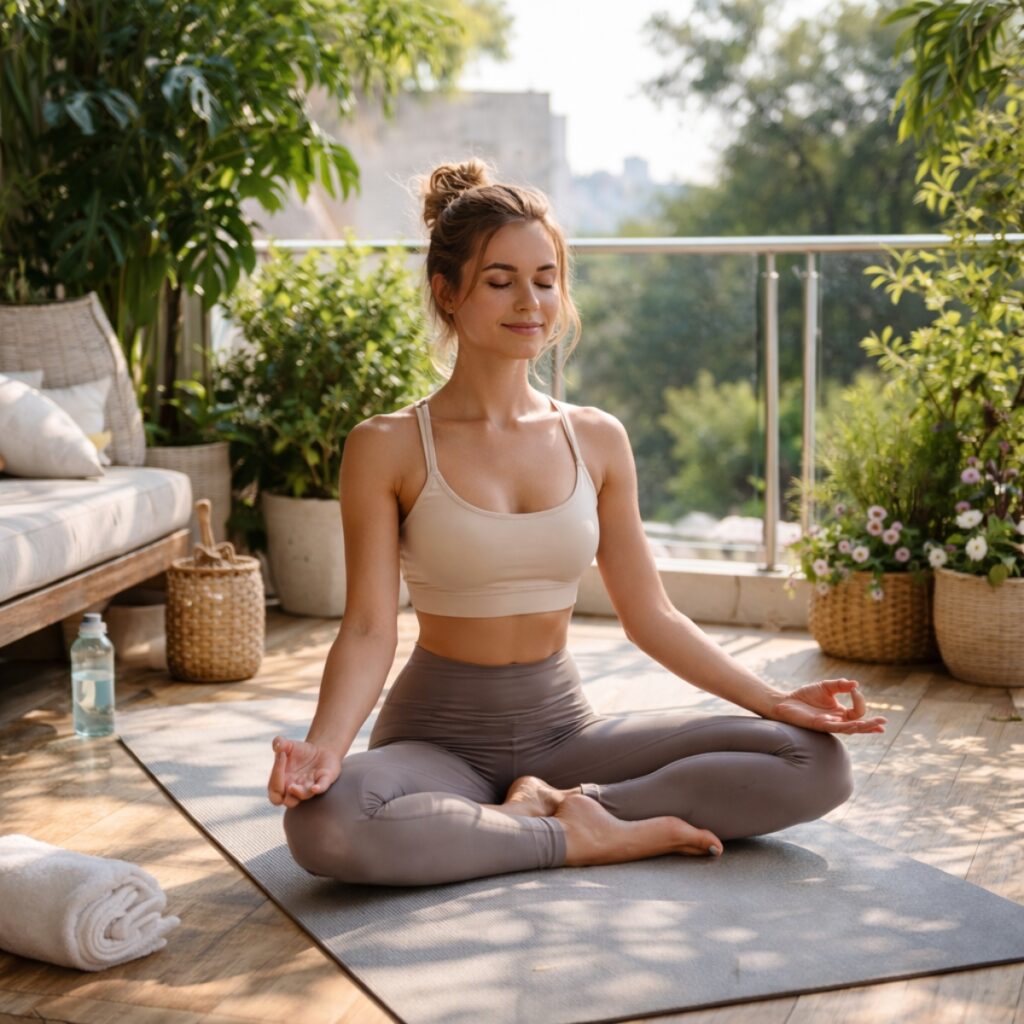
The Essence of Yoga: More Than Movement
When most people think of yoga, images of flowing sequences and challenging poses come to mind. While the physical practice, known as asana, is certainly valuable, it represents only one limb of the vast tree of yoga. The ancient yogic tradition offers us a comprehensive philosophy for living with intention, clarity and peace.
Yoga as a way of life invites us to recognize that every action, every breath and every interaction becomes an opportunity for practice. When we wash dishes with full attention, we practice yoga. When we listen deeply to a friend without planning our response, we practice yoga. When we pause before reacting in anger, we practice yoga. This expanded understanding transforms the ordinary into the sacred.
The beauty of embracing yoga as a way of life lies in its accessibility. You don’t need special equipment, a specific location, or even a yoga mat. The practice lives in your awareness, travels with you wherever you go and asks only that you show up fully for your own experience.
Cultivating Awareness: The Foundation of Yogic Living
Awareness forms the bedrock of yoga as a way of life. In yogic philosophy, this quality is called “smriti” mindfulness or remembering. It’s the gentle practice of bringing our attention back to the present moment, again and again, with patience and kindness.
In our modern lives, we often operate on autopilot. We eat meals while scrolling through our phones, commute to work lost in thought and move through entire conversations without truly hearing the person before us. This habitual distraction creates a sense of disconnection, from ourselves, from others and from the richness of life itself.
Yoga as a way of life asks us to wake up from this trance. It encourages us to notice the sensation of water on our skin during a shower, to feel the earth beneath our feet as we walk, to taste our food with genuine curiosity. These simple acts of awareness become profound when practiced consistently.
At Simar Yoga, we guide students in developing this quality of presence both on and off the mat. The focused attention we cultivate during asana practice, noticing the quality of our breath, the sensations in our body, the movements of our mind, becomes training for life itself.
Integrating the Yamas: Ethical Foundations for Daily Life
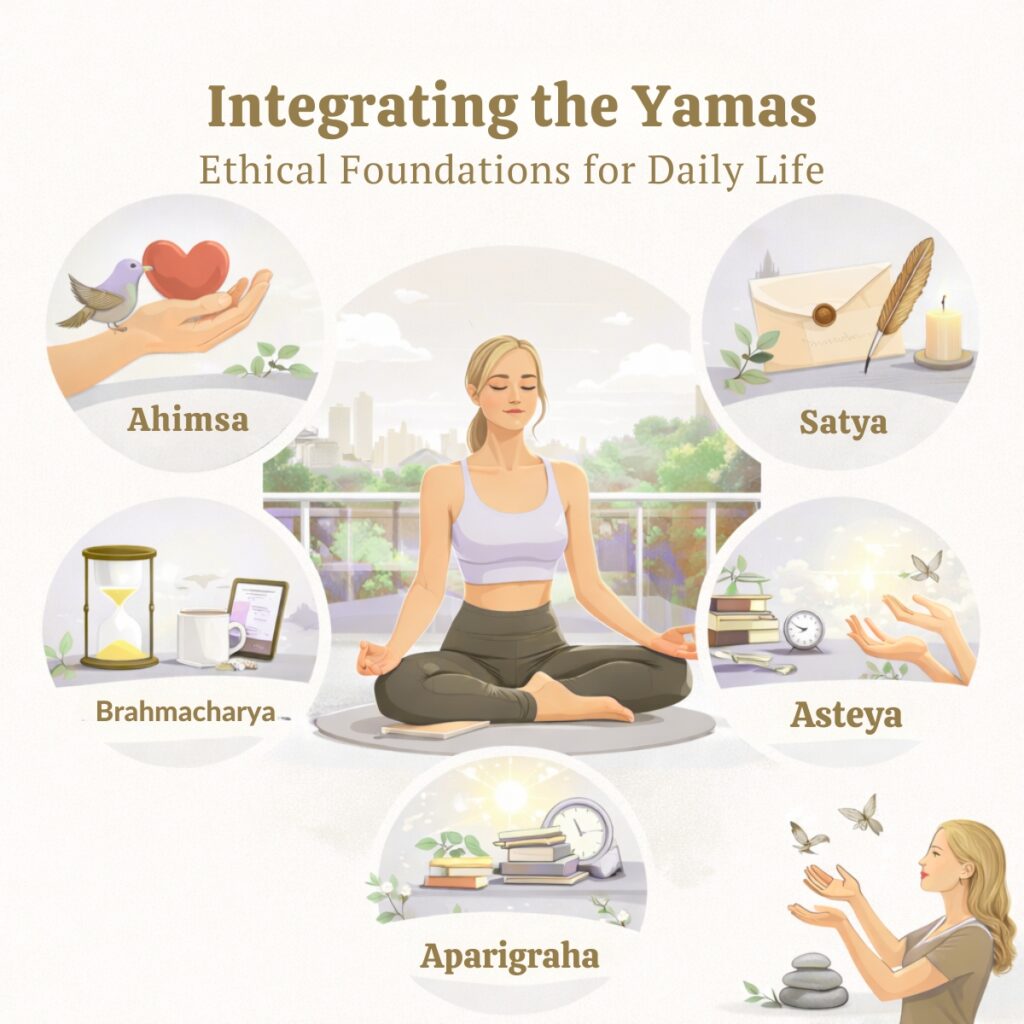
The yamas represent the first limb of Patanjali’s eight-limbed path and provide ethical guidelines for how we interact with the world around us. Integrating these principles transforms yoga as a way of life from a personal practice into a force for collective wellbeing.
Ahimsa: Non-Violence in Thought, Word and Deed
Ahimsa, or non-violence, invites us to examine how we cause harm, often unintentionally, through our thoughts, words and actions. Practising ahimsa means speaking kindly to ourselves when we make mistakes, choosing compassionate words even in difficult conversations and considering the impact of our choices on other beings and the environment.
When we embrace yoga as a way of life through the lens of ahimsa, we might choose to eat more mindfully, reduce our consumption, or simply pause before sending an angry email. We recognize that violence towards ourselves through harsh self-criticism or pushing beyond our limits contradicts the very essence of yogic practice.
Satya: Living in Alignment with Truth
Satya asks us to live authentically and speak truthfully, while balancing this commitment with ahimsa. This means honouring our genuine feelings and needs rather than performing for others’ approval. It means saying no when we need to, expressing our boundaries clearly and showing up as we truly are.
Yoga as a way of life, guided by satya, becomes an ongoing practice of integrity. We align our actions with our values, even when it’s uncomfortable. We’re honest about our limitations and generous in acknowledging our gifts.
Asteya: Non-Stealing and Generosity of Spirit
Asteya extends beyond not taking what isn’t ours. In yoga as a way of life, this principle asks us to examine subtler forms of taking demanding others’ time and attention, taking credit for collaborative work, or hoarding resources we don’t need while others go without.
Practicing asteya cultivates generosity and contentment. We share our knowledge freely, give others the credit they deserve and trust in abundance rather than operating from scarcity.
Brahmacharya: Wise Use of Energy
Traditionally associated with celibacy, brahmacharya in modern yoga as a way of life relates to how we use our vital energy. Are we dissipating our life force through endless distraction, excessive consumption, or depleting relationships? Or are we channeling our energy towards what truly matters?
This principle invites us to set healthy boundaries with technology, to be selective about where we invest our time and attention and to cultivate relationships and activities that replenish rather than drain us.
Aparigraha: Non-Attachment and Letting Go
Aparigraha teaches us to hold our possessions, relationships and even our identities lightly. When we practice yoga as a way of life through aparigraha, we learn to release what no longer serves us, whether that’s physical clutter, outdated beliefs, or the need to control outcomes.
This doesn’t mean we stop caring or striving. Rather, we engage fully while remaining open to change, knowing that grasping and clinging create suffering.
The Niyamas: Personal Practices for Inner Harmony
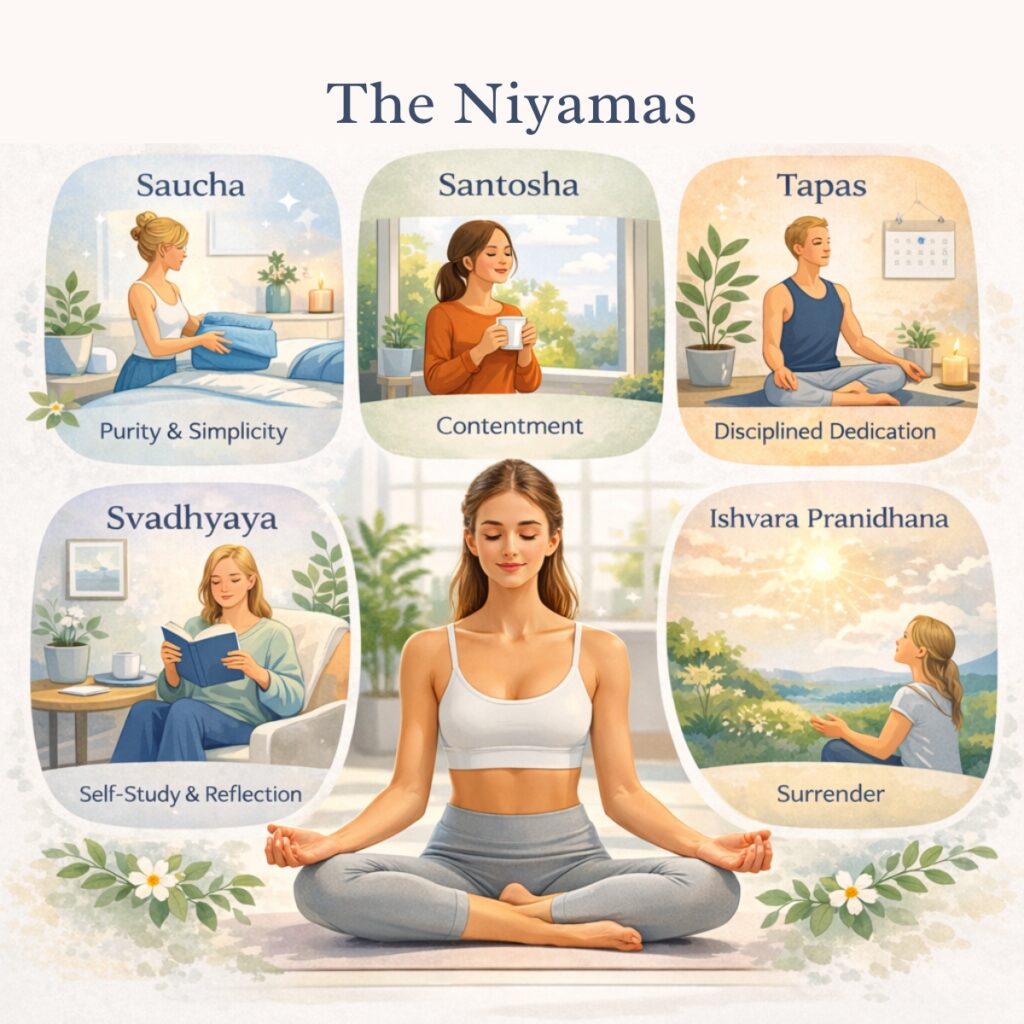
While the yamas guide our external conduct, the niyamas offer practices for inner development, essential aspects of yoga as a way of life that nurture our relationship with ourselves.
Saucha: Purity and Simplicity
Saucha encompasses both external cleanliness and internal clarity. In yoga as a way of life, this might mean keeping our living spaces organized, choosing nourishing foods, or regularly clearing our minds through meditation and reflection.
This practice extends to our mental and emotional environments as well. We become mindful of the media we consume, the conversations we engage in and the thoughts we repeatedly entertain. We create space for what uplifts and clarifies.
Santosha: Contentment in the Present Moment
Perhaps one of the most challenging aspects of yoga as a way of life in our goal-oriented culture, santosha asks us to find completeness in what is, rather than constantly reaching for what’s next. This doesn’t mean complacency, but rather cultivating gratitude and peace with our current circumstances while still working towards growth.
We can hold ambition and contentment simultaneously, striving with joy rather than from a sense of lack.
Tapas: Disciplined Dedication
Tapas, often translated as “heat” or “discipline,” represents our commitment to practice even when it’s difficult. In yoga as a way of life, tapas looks like showing up to our meditation cushion when we’d rather stay in bed, maintaining our integrity when it would be easier to compromise, or persisting in challenging conversations rather than shutting down.
This quality of dedication creates transformation. Like a fire that purifies metal, tapas burns away what’s unnecessary and reveals our essential nature.
Svadhyaya: Self-Study and Reflection
Yoga as a way of life requires honest self-examination. Svadhyaya invites us to observe our patterns, question our assumptions and remain curious about our inner landscape. This might take the form of journaling, therapy, spiritual reading, or simply pausing throughout the day to check in with ourselves.
Through svadhyaya, we develop the wisdom to recognize when we’re operating from old wounds, unconscious biases, or conditioned reactions. This awareness creates the possibility for conscious choice.
Ishvara Pranidhana: Surrender to Something Greater
The final niyama asks us to recognize that we’re part of something larger than ourselves and to surrender our small will to a greater wisdom. Whether we call this God, nature, universal intelligence, or simply the mystery of existence, yoga as a way of life invites us to release our grip on control and trust the unfolding of life.
This surrender paradoxically empowers us. When we stop exhausting ourselves trying to micromanage every outcome, we free up energy for aligned action and genuine presence.
Breath as Bridge: Pranayama in Daily Life
In yoga as a way of life, the breath becomes our constant companion and teacher. The ancient practice of pranayama, breath regulation, extends far beyond formal breathing exercises. It becomes a tool for navigating challenges, returning to centre and cultivating energy throughout our day.
When we notice tension building in our shoulders during a stressful work meeting, we can invite a few deeper breaths. When we feel anxious before a difficult conversation, we can ground ourselves through conscious breathing. When we need to transition between activities, we can use the breath to create a mindful pause.
The breath also serves as a barometer for our internal state. Shallow, rapid breathing signals stress or anxiety. Long, smooth breaths indicate calm and presence. By simply noticing our breath throughout the day, we gather valuable information about our nervous system and can respond with appropriate care.
At Simar Yoga, we teach students to befriend their breath, to see it not as something to be controlled, but as a wise guide always offering feedback about our current state. This relationship with breath becomes one of the most accessible aspects of yoga as a way of life.
Meditation Beyond the Cushion
While formal meditation practice offers immense benefits, yoga as a way of life extends meditative awareness into all our activities. This is sometimes called “meditation in action” or “informal practice.”
Washing dishes becomes a meditation when we feel the warm water on our hands, notice the patterns of bubbles and attend fully to the simple task before us. Walking becomes meditation when we synchronize our steps with our breath and allow our senses to drink in our surroundings. Even waiting in line at the grocery store becomes meditation when we use the time to observe our impatience with curiosity rather than judgment.
These moments of informal practice are not lesser than seated meditation, they’re essential expressions of yoga as a way of life. They train us to access presence regardless of external circumstances, developing a portable peace that doesn’t depend on perfect conditions.
The key is remembering to practice. We might set gentle reminders, a specific doorway we pass through becomes a cue to take three conscious breaths, or the sound of our phone ringing prompts us to pause and centre before answering. Over time, these moments of awareness accumulate, gradually shifting our baseline state towards greater presence and peace.
Navigating Difficulty with Yogic Wisdom
One of the most valuable aspects of yoga as a way of life is the framework it provides for meeting challenges. Rather than seeking to eliminate difficulty, an impossible goal, yoga teaches us to change our relationship with the inevitable obstacles and discomfort of human existence.
The concept of “sthira sukham asanam” from the Yoga Sutras offers profound guidance. Traditionally applied to physical postures, this principle suggests finding a balance between effort and ease, stability and comfort. When we apply this to yoga as a way of life, we learn to engage with challenges without either collapsing under their weight or rigidly resisting them.
We can bring steadiness to difficult emotions by acknowledging them without being overwhelmed. We can apply appropriate effort towards our goals while also resting in trust. We can remain stable in our values while adapting our strategies as circumstances change.
Yoga as a way of life also teaches us about impermanence, the truth that all things change. When we’re suffering, this truth offers hope. When things are going well, it invites us to savour the present moment rather than taking it for granted. Neither clinging to pleasure nor pushing away pain, we learn to ride the waves of life with greater grace.
Community and Connection: Sangha as Practice
While yoga as a way of life certainly includes solitary practices, it also emphasizes the importance of community, what Buddhist tradition calls “sangha.” At Simar Yoga, we understand that practicing together amplifies our individual efforts and provides crucial support for the journey.
Community offers us mirrors for our own growth. When we see others struggling with similar challenges, we feel less alone. When we witness someone embodying a quality we wish to develop, we’re inspired. When we share our own experiences vulnerably, we give others permission to do the same.
Yoga as a way of life practiced in community also creates accountability. It’s easier to maintain our commitments when we’re supported by others who share our values and aspirations. Whether it’s a regular class, a study group, or simply a friend who also walks this path, connection sustains our practice through inevitable difficulties.
Moreover, practicing together helps us refine the balance between self-focus and service. While yoga requires dedicated attention to our own development, it ultimately aims to reduce suffering for all beings. In community, we learn to hold both intentions, caring for ourselves while also showing up for others.
Bringing Yoga Home: Creating Sacred Space in Ordinary Life
You don’t need a dedicated yoga room to practice yoga as a way of life, but creating spaces that support your practice can be tremendously helpful. This might mean setting up a small corner for meditation, keeping inspiring texts nearby, or simply arranging your environment to minimize distraction and maximize peace.
Sacred space is less about aesthetics and more about intention. Even a single candle lit mindfully can transform an ordinary room into a sanctuary. A cushion placed by your bed can serve as a morning meditation spot. A particular chair can become your reading and reflection place.
These physical anchors support yoga as a way of life by providing environmental cues that remind us to practice. They create thresholds between the reactive mode many of us default to and the responsive, aware mode we cultivate through yoga.
The practice extends to how we structure our time as well. Morning and evening routines bookend our days with intentionality. Regular meal times practised mindfully become nourishing rituals. Even the way we transition between activities, pausing for three breaths before checking email, or stretching gently after sitting for long periods, weaves yoga as a way of life into the rhythm of our days.
The Ongoing Journey: Patience and Practice
Perhaps the most important understanding about yoga as a way of life is that it’s exactly that, a way of life, not a destination to reach. There’s no graduation ceremony where we receive our diploma in yogic living. Rather, it’s an ongoing practice of returning, again and again, to awareness and intention.
Some days we’ll embody the principles beautifully. Other days we’ll forget everything we know and react from old patterns. Both experiences are part of the path. Yoga as a way of life includes compassion for our own humanity, our mistakes and our continuous learning.
The practice asks for consistency rather than perfection. Even five minutes of daily meditation matters more than an occasional hour. A single conscious breath in the midst of stress creates change. One meal eaten without distraction nourishes us on multiple levels.
At Simar Yoga, we honour each person’s unique journey while providing guidance, support and inspiration for the path. We recognize that yoga as a way of life looks different for everyone; what matters is not following someone else’s prescription but discovering what helps you live with greater awareness, compassion and authenticity.
You may also read our blog “Beginner Yoga Practice: How to Start Your Practice Mindfully“
Conclusion: An Invitation to Begin
Yoga as a way of life is both ancient wisdom and contemporary practice, both deeply personal and inherently communal, both simple and endlessly profound. It asks nothing more than your sincere willingness to show up for your own experience with honesty and kindness.
You don’t need to change everything at once. Perhaps you begin by taking three conscious breaths when you wake up. Maybe you choose one meal a day to eat without distraction. You might start noticing when you’re running on autopilot and gently bringing yourself back to presence.
These small seeds of practice, tended with patience and dedication, grow into a life transformed, not through dramatic upheaval but through the gradual alignment of your daily actions with your deepest values. This is yoga as a way of life: not an escape from the ordinary, but a complete embrace of it, finding the extraordinary in each moment when we bring our full awareness and care.
At Simar Yoga, we walk this path together, supporting one another in living yoga not just on the mat, but in every breath, every choice, every moment of our precious lives. The journey begins now, with this breath, with this moment, with your willingness to live a little more consciously, a little more compassionately, a little more fully.
May your practice nourish you. May your awareness deepen. May you discover, again and again, the peace and presence that is your true nature.